Custom Software vs Ready-Made Software: Which Is Better for Your Business?
Understand the differences between custom software and ready-made software. Explore their costs, benefits, limitations, scalability, and how to choose the right solution for your business.
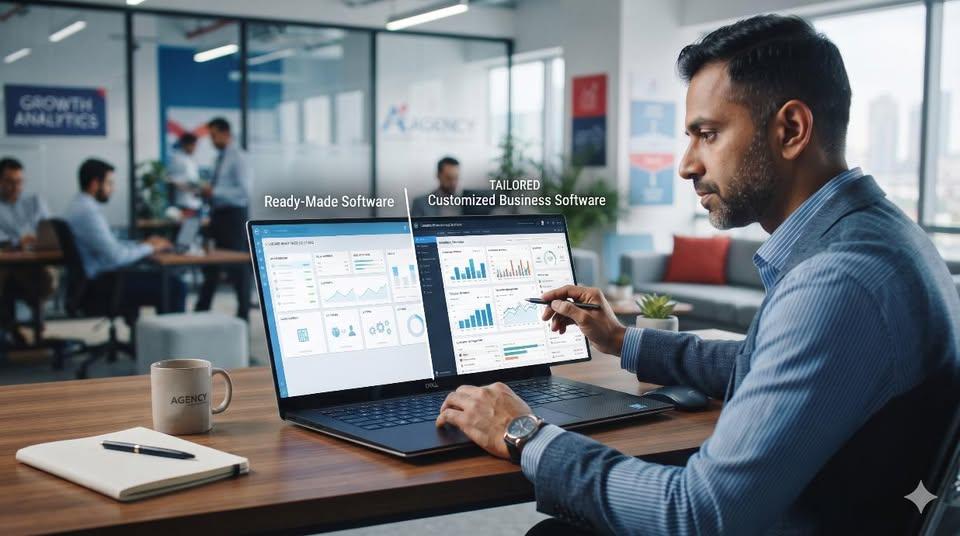
Custom Software vs Ready-Made Software: Which Is Better for Your Business?
Technology plays an important role in how modern businesses operate. From managing customers and tracking orders to handling employees and monitoring daily operations, software helps businesses save time and organize their work.
However, choosing the right software can be challenging.
Should you purchase an existing software solution or invest in custom software developed specifically for your business?
Both options have advantages and limitations. The right choice depends on your business requirements, budget, operational processes, and future growth plans.
In this guide, we compare custom software vs ready-made software to help businesses in Bhubaneswar, Cuttack, and across Odisha make an informed decision.
What Is Ready-Made Software?
Ready-made software is a pre-developed application designed to serve the needs of multiple users or businesses.
It usually comes with standard features that customers can access through a subscription or one-time purchase.
Examples include:
Accounting software
Customer relationship management (CRM) tools
Project management platforms
Inventory management applications
Payroll software
Email marketing tools
Ready-made software is generally designed for common business requirements and can often be used shortly after registration or installation.
Advantages of Ready-Made Software
1. Faster Implementation
Since the software is already developed, businesses can usually start using it without waiting for a complete development process.
2. Lower Initial Investment
Many ready-made solutions offer affordable subscription plans, making them suitable for businesses with limited initial budgets.
3. Regular Updates
Software providers may offer updates, bug fixes, security improvements, and additional features as part of their service.
4. Technical Support
Depending on the subscription plan, users may receive customer support, documentation, and troubleshooting assistance.
Limitations of Ready-Made Software
Ready-made software may not meet every business requirement.
Some common limitations include:
Limited customization
Features that your business does not need
Missing features for specific workflows
Subscription costs over time
Dependence on the software provider
Integration limitations
Restrictions on data access or portability
For businesses with unique processes, these limitations may become difficult to manage.
What Is Custom Software?
Custom software is developed specifically to meet the requirements of an individual business or organization.
Instead of adapting your business processes to an existing application, the software is designed around the way your business operates.
Examples include:
Custom inventory management systems
Employee management portals
Customer management platforms
Online booking systems
Business dashboards
Order management applications
Custom reporting tools
Industry-specific software
Custom software development usually involves understanding requirements, planning features, designing the interface, developing the application, testing, and deployment.
Advantages of Custom Software
1. Designed Around Your Business
Custom software can be built according to your actual workflows and operational requirements.
2. Greater Flexibility
You can prioritize the features your business needs rather than depending entirely on a standard feature set.
3. Better Integration Possibilities
Custom applications can be designed to integrate with other business systems, APIs, and tools where technically feasible.
4. Scalability
As your business grows, the software can be extended with additional modules and functionality, depending on the architecture.
5. Greater Control Over Features
You can define how different parts of the application should work and how users interact with them.
Limitations of Custom Software
Custom software also comes with responsibilities and costs.
Some considerations include:
Higher initial development investment
Longer development timelines
Requirement planning and testing
Ongoing maintenance
Security updates
Dependence on the development and support arrangement
Businesses should plan for long-term maintenance rather than considering only the initial development cost.
Custom Software vs Ready-Made Software: Key Differences
| Comparison Factor | Ready-Made Software | Custom Software |
|---|---|---|
| Development | Already developed | Built for specific requirements |
| Initial Cost | Often lower | Usually higher |
| Implementation | Generally faster | Requires development time |
| Customization | Limited or plan-dependent | Designed around requirements |
| Scalability | Depends on provider and plan | Can be planned around business growth |
| Features | Standard features | Business-specific features |
| Maintenance | Usually managed by provider | Depends on development agreement |
| Integration | Depends on available integrations | Can be designed for required integrations |
| Ownership | Usually licensed or subscription-based | Depends on contract and IP agreement |
Neither option is automatically better. The right solution depends on what your business needs.
When Should You Choose Ready-Made Software?
Ready-made software may be a suitable choice when:
1. Your Business Has Standard Requirements
If your business needs common functions such as invoicing, accounting, or basic project management, an existing tool may be sufficient.
2. You Have a Limited Budget
Subscription-based software can help businesses avoid a large initial development expense.
3. You Need a Quick Solution
If you need to start managing your operations immediately, ready-made software may be more practical.
4. You Do Not Need Extensive Customization
When the available features match your requirements, developing a separate application may not be necessary.
When Should You Choose Custom Software?
Custom software may be a better option when:
1. Your Business Has Unique Workflows
If your business follows processes that standard software cannot support, a customized application may be more suitable.
2. You Need Multiple Systems to Work Together
Businesses that use different tools may benefit from a centralized system designed to connect their workflows.
3. You Want Business-Specific Features
You may require features that are unavailable in standard applications or would need expensive upgrades.
4. Your Business Is Planning Long-Term Growth
If your operational requirements are expected to become more complex, custom software can be designed with future expansion in mind.
5. You Need More Control Over Your Software
Custom development may provide more control over functionality, architecture, and integrations, depending on the contract and technical arrangement.
How Much Does Custom Software Development Cost?
Custom software development costs depend on the complexity and scope of the project.
Some important pricing factors include:
Number of features
Application complexity
UI and UX design
Technology stack
Third-party integrations
Database requirements
Security requirements
Testing and deployment
Maintenance and support
A basic internal tool may require less development effort than a complex enterprise application.
Before requesting a quotation, prepare a list of your essential features and business requirements.
This helps developers estimate the project more accurately.
Important Factors to Consider Before Choosing Software
Before selecting a software solution, ask yourself these questions:
What business problem do I want to solve?
Which features are essential?
Can ready-made software handle my current requirements?
Will I need additional features in the future?
What is my initial and long-term budget?
Does the software integrate with my existing tools?
Who will manage updates and maintenance?
How will my business data be stored and protected?
Answering these questions can help you avoid unnecessary investment and choose a suitable solution.
Real-World Example: A Growing Business in Odisha
Imagine a distribution company operating in Bhubaneswar.
Initially, the company uses spreadsheets to manage stock, orders, and customer details.
As the business grows, employees begin facing difficulties with:
Tracking inventory
Managing customer records
Monitoring orders
Generating reports
Coordinating different departments
The company could first evaluate whether an existing inventory or business management platform meets its requirements.
If standard software cannot support its workflows or integrations, a custom business application may be worth considering.
This example demonstrates why software decisions should be based on actual business needs rather than trends.
How Odizo Can Help With Custom Software Development
Odizo provides technology and digital solutions for businesses looking to improve their online presence and business operations.
Our services include:
Custom Software Development
Application Development
Website Development
Software Consulting
Digital Marketing
Search Engine Optimization
Social Media Marketing
Whether you need a business website, an application, or a customized software solution, the development process should begin with understanding your requirements.
Our approach focuses on identifying business needs and exploring suitable technology solutions.
If you are considering custom software for your business in Bhubaneswar, Cuttack, or elsewhere in Odisha, connect with Odizo to discuss your project requirements.
Frequently Asked Questions
1. What is the main difference between custom and ready-made software?
Ready-made software is developed for general users and businesses, while custom software is designed around the specific requirements of an individual organization.
2. Is custom software more expensive?
Custom software generally requires a higher initial investment because it involves requirement analysis, design, development, and testing. However, the overall value depends on how well it supports your business needs and long-term operations.
3. Is ready-made software suitable for small businesses?
Yes. Ready-made software can be a practical option for small businesses with standard requirements and limited development budgets.
4. Can custom software grow with my business?
Custom software can be designed with future expansion in mind. However, scalability depends on the software architecture, infrastructure, and ongoing development.
5. How long does custom software development take?
The timeline depends on project complexity, features, integrations, testing, and the availability of requirements. A simple application may take less time than a complex business platform.
6. Does custom software require maintenance?
Yes. Custom software requires ongoing maintenance, security updates, bug fixes, and technical support to remain reliable and functional.
7. Which is better for businesses in Odisha?
There is no single answer. Businesses with standard requirements may prefer ready-made solutions, while organizations with specialized workflows may benefit from custom software development.
Conclusion
Choosing between custom software and ready-made software is an important business decision.
Ready-made software can be suitable when your requirements are standard, your budget is limited, and you need a quick solution.
Custom software may be more appropriate when your business needs specialized features, unique workflows, or greater flexibility.
Before investing, evaluate your requirements, compare long-term costs, and consider future business needs.
Looking for a software solution that fits your business? Contact Odizo to discuss your custom software development requirements.
More Helpful Articles
View all articles7 Reasons Your Business Website Is Not Getting Customers
Is your business website failing to generate customers? Discover 7 common website problems and learn how SEO, website speed, mobile optimization, and effective CTAs can help attract visitors and generate more leads.